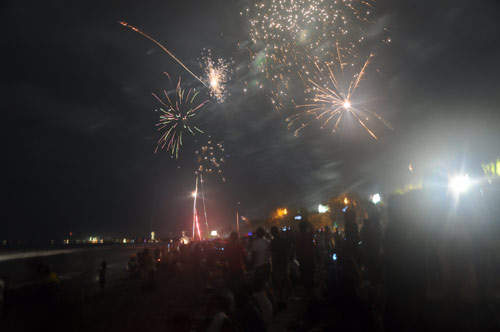
Celebration about Christian or Gregorian New Year2018
1st January 2018 is New year day of Gregorian calendar and Christian New year Day. On this day all world people celebrated New year day.This day is believed to have a Romanian origin. Janus, the God of beginnings after whom the month January was named, was the one to whom the day was dedicated. Janus had two faces- one at the front and the other at the back. Thus, the tradition of celebrating New Year's Day came to be associated with paganism.

New Year ushers in the festive spirit. People splurge in the New Year activities with fun and excitement. New Year brings in happiness and so people make it a grand affair to welcome the coming year. New Year celebrations begin with the New Year Eve. Christians attend balls, theme and private parties to celebrate the New Year. Party halls are booked in advance and there is rarely any place which is not hit by the partiers. Festive music and songs rock the New Year parties. People dress up in their best clothes to celebrate the New Year. At the stroke of 12 at midnight, people make a lot of noise, hug, kiss and wish each other “Happy New Year”.
New dawn is welcomed with open arms by the Christians. Even after partying all night, Christians don't delay to visit the church on the New Year's Day. They spend the day with family and friends, go to picnics, watch movies and have favorite meals.
New Year History
The celebration of the new year is the oldest of all holidays. It was first observed in ancient Babylon about 4000 years ago. In the years around 2000 BC, the Babylonian New Year began with the first New Moon (actually the first visible cresent) after the Vernal Equinox (first day of spring).
The beginning of spring is a logical time to start a new year. After all, it is the season of rebirth, of planting new crops, and of blossoming. January 1, on the other hand, has no astronomical nor agricultural significance. It is purely arbitrary.
The Babylonian new year celebration lasted for eleven days. Each day had its own particular mode of celebration, but it is safe to say that modern New Year's Eve festivities pale in comparison.
The Romans continued to observe the new year in late March, but their calendar was continually tampered with by various emperors so that the calendar soon became out of synchronization with the sun.
In order to set the calendar right, the Roman senate, in 153 BC, declared January 1 to be the beginning of the new year. But tampering continued until Julius Caesar, in 46 BC, established what has come to be known as the Julian Calendar. It again established January 1 as the new year. But in order to synchronize the calendar with the sun, Caesar had to let the previous year drag on for 445 days.
Although in the first centuries AD the Romans continued celebrating the new year, the early Catholic Church condemned the festivities as paganism. But as Christianity became more widespread, the early church began having its own religious observances concurrently with many of the pagan celebrations, and New Year's Day was no different. New Years is still observed as the Feast of Christ's Circumcision by some denominations.
During the Middle Ages, the Church remained opposed to celebrating New Years. January 1 has been celebrated as a holiday by Western nations for only about the past 400 years.